The Room Before the Note
The air is a held breath. An amber filament, cradled in glass, glows like a trapped ember. It casts a sphere of warmth against the darkness, a small sun for your intent. You have brushed the platter. You have felt the spindle’s cool, perfect circle. The tonearm lowers, a gravity of its own. This is the silent liturgy.
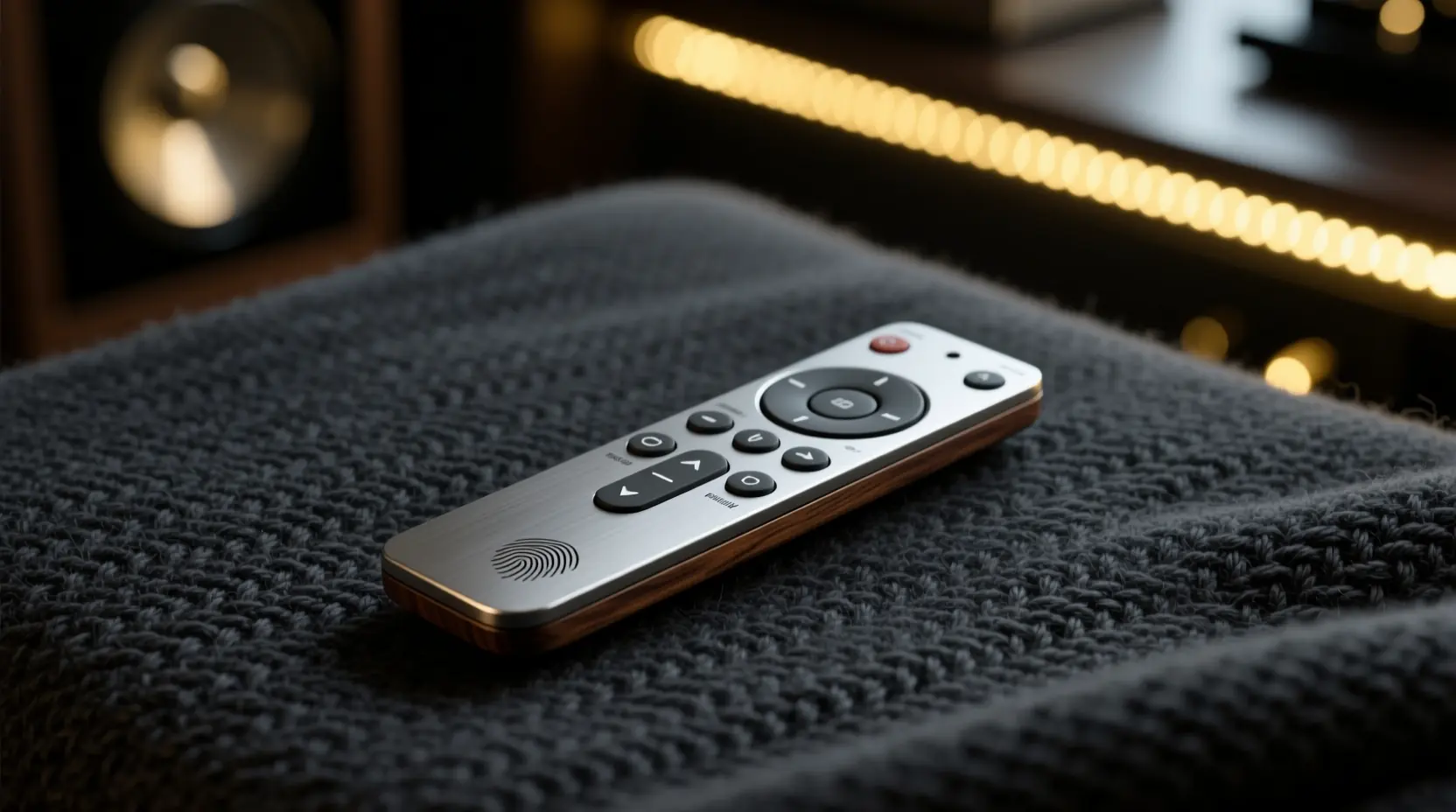
And then, the reach. The final, tactile threshold. The remote. It is not a key. It is the hand that turns the key. The last point of human touch before the wave of pure sound begins to unfurl from the silence you have cultivated. Its material, its weight, the very dialect it speaks to your components—this is the last edit on the score of your evening.
We sit with two languages of control. The ancient, direct light. And the unseen, whispering wave. We ask not which is faster, louder, better. We ask which is more true.
The Beam of Intention: Infrared’s Silent Line
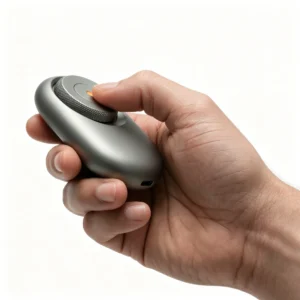
Infrared is a beam of focused will. Invisible, but direct. A line of sight drawn from your hand to a small, dark eye on the face of your amplifier. To use it is a deliberate act of aiming. You point. You press. You feel the subtle, satisfying click under your thumb—a damped, soft-touch button set into brushed aluminum. A cool, heavy disc of anodized steel. Acknowledged by a tiny, respectful red star blinking once in the dark.
There is a purity in this limitation. The beam must travel. It must find its receiver. This requires presence. You cannot be elsewhere, mind wandering. You must be here, in the listening space, your body oriented toward the sound, toward the rack. The remote becomes an extension of your focus. A tether to the physical realm of your system.
Its silence is profound. It speaks in a flash of light, then is gone. It adds no noise to the room, no digital chatter to the ether. It is a momentary, silent command that leaves no trace in the air. Like a stone dropped into a still pond, the ripple is the sound that follows, not the stone itself. Its limitation is its virtue: a defined sphere of influence, a requirement for mindful engagement. In a dedicated room, where the rack is a sacred altar in your line of sight, IR feels correct. It is part of the ceremony.
But light is fragile. It fears obstruction. A book. A passing figure. The connection breaks. The command is lost, swallowed by the room. The spell, for a moment, is broken. Is this a flaw? Or is it the system’s gentle whisper, asking for your undivided attention once more?
The Unseen Whisper: Radio Frequency’s Atmospheric Will
Radio Frequency is a different kind of magic. It is not a beam, but an atmosphere. A thought made manifest in the air itself. An RF remote speaks not to a single, focused eye, but to a small, listening ear hidden within a component. There is no aiming. The command exists everywhere in the room at once. From the kitchen as you rinse a glass. From the library as you search for the next album. Through the solid walnut door.
This feels like freedom. Omnipresence. The ritual changes. It becomes less about the precise, physical orientation of the moment, and more about the continuous, fluid environment of sound. You shape the acoustic space from within it, from any point. Your touch on the remote—a warmly-grained walnut shell fitted to your palm—alters the world without a visible signal. An act of will, immediate and unbounded.
There is a subtle power here, a seamlessness that borders on the psychic. The system responds as if reading your mind. Volume rises as you sink into your chair. The source changes as you walk toward the rack. It eliminates the stumbles, the moments where the ritual falters on practicality.
Yet, we must listen to the quality of this new silence. RF is a conversation in a crowded room. It shares the air with other whispers—Wi-Fi, Bluetooth, the digital pulse of a modern home. While a shielded, well-designed system is a citadel, the potential for a faint, digital haze exists. More profoundly, its omnipresence can dilute the ritual. When you can control from anywhere, does the act become casual? Does it lose the weight of a deliberate gesture? The remote is no longer a bridge you must cross; it is a wand you wave over your environment.
The Weight in the Hand: The Object as Artifact
Let us consider the object itself. In a world of disposable plastic, the hi-fi remote is an artifact. It must have mass. Consequence. Cold, heavy steel that warms slowly in your grasp. Brushed aluminum with edges softened by a machinist’s patience. The organic texture of sand-cast zirconium. The deep, resonant warmth of aged walnut.
This tactile truth is paramount. The click of a button is a note in the silent overture to the music. It must be damped. Precise. A mechanical event that speaks of quality before a single sound wave is released. Whether it speaks in light or in radio waves, the primary conversation is between your fingers and the object. This is the human touch. The ceremony begins here.
IR remotes, often simpler, can achieve a sublime, focused physicality. A single, perfect cylinder of metal. One dial for volume. Nothing more. RF remotes, enabling complex control, can become elaborate. But elaboration must not cost feel. Every button, every scroll wheel, must serve the touch. Must deepen the connection.
Choosing Your Ritual: A Question of Temple and Prayer
So, which guardian serves your temple?
If your rack is a fixed point in a dedicated space—a shrine you approach with intention—then the focused, silent purity of IR may be your truth. It honors the tradition. It demands your presence. It adds nothing to the air but your command. Its limitation is its meditation. It says: Be here. Listen. This moment, this alignment, is everything.
If your system is the heart of a living space, if music flows through your daily movements and you wish to conduct it from within its current, then the unseen, atmospheric embrace of RF may be your path. It offers seamless integration. It turns your home into an instrument. It is the modern magic of convenience, but it must be implemented with care. With shielding. With the same reverence for silent operation that defines the amplifiers it commands.
In the end, the best protocol is the one that dissolves. The one you do not think about. The one that feels less like operating a device and more like extending your will toward the music. It is the difference between flipping a switch and turning a key. Both grant access, but one feels like a transaction, the other an initiation.
Reach for your remote now. Feel its weight. Listen to the quiet of your room. Does the act of pressing a button feel like aiming a beam of your own attention? Or does it feel like whispering a wish to the room itself?
The answer is not in a spec sheet. It is in the pause before the music begins. It is in the quality of the silence you have worked so hard to create, and in the respectful, tactile way you choose to break it. Choose the keeper that guards your quiet most faithfully. The music that follows will always feel like your own.