In the Chamber of Stillness, a Cold Weight
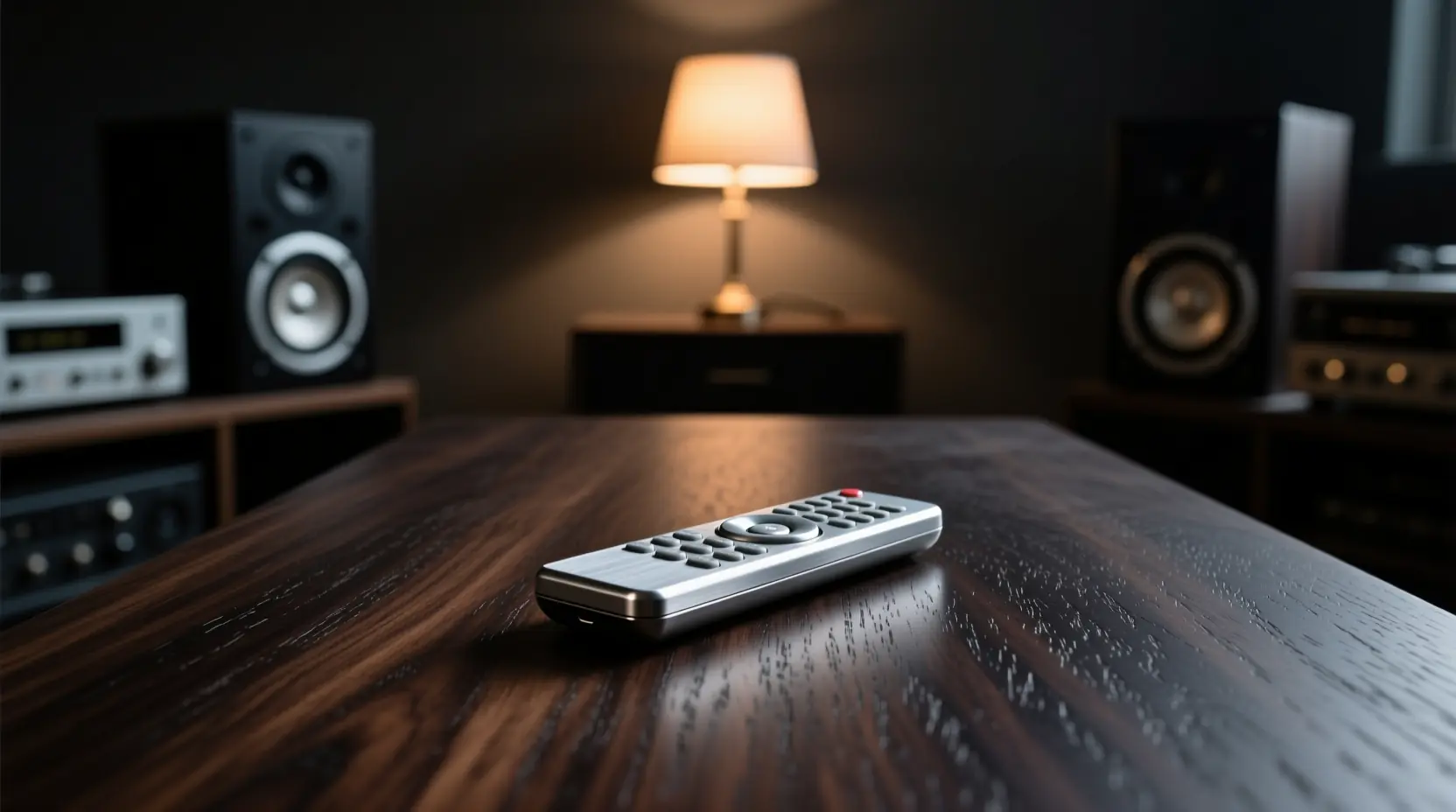
The light is a trespasser here. A single, amber pool, contained. It licks the edge of brushed aluminum, catches the deep, silent grain of oiled walnut. The air is not empty. It is full. Charged with the absence of sound, a fertile void. Your hand moves through this charged space. Not toward the frantic, buzzing slab in your pocket—that reservoir of digital sirens. No. It finds, instead, a different slab. Cool. Dense. An inert geometry of purpose. It rests on the table, patient as stone. This is not a remote. This is a key. A quiet conduit. For those who wander the deeper frequencies, where sound is not heard but felt in the marrow, this tool is not convenience. It is covenant. A reclamation of the ritual, piece by deliberate piece.
The First Silence: Feeling the Break in the Circuit
You must first know the fracture. The beautiful, broken chain. Your amplifier—a monolith of discrete transistors and heat-sinked silence—answers only to a small, tired plastic rectangle. Your transport, a relic of obsessive engineering, offers none. To play. To pause. To seek. You must rise. You must cross the room. The spell, so carefully woven, unravels at the seam of necessity. The modern gospel sings of seamless integration, of glowing apps that promise control but deliver only distraction. They are bridges of noise. We seek to eliminate noise. All noise. Even the noise of interruption. The silent scream of a broken circuit.
The Pedagogy of Light: A Slow Dance in Infrared
This is the heart of it. The IR learning function. A clinical term for a profoundly human act. Teaching. It is a slow sacrament.
Nose to Nose, Whisper to Whisper
You lay them on a soft cloth. The old commander of your transport, its buttons worn smooth by devotion. And your new sentinel. You press ‘Play’ on the old. A faint, red flicker at its tip—a silent, optical sigh. Immediately, you press the corresponding button on the cold slate. You hold. A breath. A tiny LED blinks. Once. Twice. An acknowledgement. It has heard the whisper. It has learned the word.
This is not programming. This is translation. You are archiving a dying dialect of light into this steadfast vessel. Each press is a transfer of trust. Power. A deep, satisfying click travels up your fingerbone. Stop. A softer, final punctuation. Track Forward. You imagine this learned pulse, this unique signature, stored in a tiny cell of memory. Sleeping. Perfect. Waiting for your will.
Weaving the Single Thread
You proceed. Volume Up. Volume Down. Source Select. Mute. The process is monastic. There is no hurry. With each learned command, you are not building a controller. You are weaving a single, unbroken thread of intent through your archipelago of cherished components. You are forging a singular focus from beautiful, disparate islands.
The Sentinel Assumes Its Watch
The teaching is done. The old remotes are retired to a drawer, their duty honorably discharged. The new conduit rests alone. In the dim light, it is merely a shape. A formless form. You need not look at it.
Here, the magic crystallizes into ritual.
The music begins. Perhaps with the gentle, gravitational fall of a stylus into vinyl groove—an act you must perform by hand, a sacred primer. You settle. The piece unfolds. A cellist draws a breath across the string. You need to adjust. Not a screen. Not a menu. Your fingers find the remote by topography alone. The textured ridge of the Volume wheel. You turn it.
The Click That Is Not a Sound
A profound, weighted thunk resonates in the joint of your thumb. A mechanical affirmation. In the distance, the soundstage expands. Not with a shout, but with a breath. The cello gains resonance, body, without ever breaking its line. The connection is pure. Immediate. Quiet. No lag. No searching for a phantom Bluetooth signal. No spinning wheel on a pane of glass. There is only intention. Tactile confirmation. Acoustic result.
The remote has vanished. It is now an extension of your diaphragm. A silent steward of your attention.
On the Exorcism of Presence
We must speak of ghosts. Not of hum or hiss, but the phantom limb of digital presence. The smartphone is a pocket of chaos. A window thrown open onto a cacophonous square. To invite it in is to compromise the sanctum. The dedicated, learning remote is a sealed door. It does one thing. It does it flawlessly, and then it returns to being an object. A beautiful, inert weight.
Its virtue is its limitation. It cannot check the weather. It cannot display a thumbnail of an album cover that is always less vivid than the landscape the music paints behind your eyes. It is a chisel. A loom shuttle. Its purpose is singular, and thus, its use is profound. The signal it sends is a clean, replicated burst of light—the exact, idiosyncratic language your orphaned gear understands. No update will break it. No OS will declare it obsolete. It is a permanent bridge, built by your own hand, syllable by infrared syllable.
The Braille of Intent
In an epoch of frictionless glass, we have forgotten texture. The smoothness offers no story, no resistance. But here, in this quiet realm, texture is data.
The volume knob is knurled aluminum, cool and definite. The source button is slightly concave, a tiny moon crater for your thumb. Play/Pause is a wide, isolated circle. You learn this topography in the dark. Your fingertips read it like braille, decoding desire. The click is a feeling. A deep, physical ‘yes’ sent back up the nerve. It is the antithesis of the vague, haptic buzz of a phone—a ghost of a sensation. This is real. This is stone and metal and consequence.
This tactile truth bleeds into the listening. If the control feels direct, honest, physical, the mind prepares for sound of the same character. You are not petitioning a nebulous cloud of code. You are pressing a physical lever that throws a pure, optical switch. The chain of causality is short. Clean. Beautiful.
The Fullness of the Empty Circle
The final note decays. Not into silence, but into a different, fuller quiet—the room now pregnant with the memory of sound. Your hand rests on the cold aluminum. It asked for nothing. It gave only silent, flawless service. You rise. To change a side. To sit in the afterglow.
This humble student, this quiet conduit, has done more than consolidate commands. It has guarded the hour. It has removed the final, mundane fractures—the fumbling for the correct wand, the intrusive glare of an LCD—that stood between you and total immersion in the acoustic stream.
For the true listener, the quest is for a perfect circuit. A loop that runs from the musician’s first spark of intention, through the groove, the coil, the transistor, the cone, through the air, to your tympanum, and finally, to the quiet center of you. Any break is a hemorrhage. Any intrusion of the ordinary world is a break.
The learning remote, this assemblage of cold steel and learned light, heals those breaks. It becomes part of the circuit. Not as a source, but as a silent, perfect switch. A gentle guide for the human hand, moving in the sacred dark.
In the end, it is not about the components, however rare. It is about the listening. It is about the careful construction of a space—physical, tactile, mental—where the only thing permitted to flow, uninterrupted, is the music. And in that hallowed space, even the simple act of raising the volume becomes a quiet, reverent part of the song itself.