The Sacred Space: Where Light is a Guest, Not a HostIn the sanctuary of your dark room, the only light that matters is the soft glow of vacuum tubes — or the cool stare of a power indicator.
You’ve carved out a vessel shaped by sound, not walls. You’ve perfected every detail: speaker placement, cable management, acoustic treatment. You’ve hunted for the perfect silence to cradle the perfect note.
But then — you need to adjust the volume.
And often, the spell breaks.
Your hand gropes in the void for a smooth, cold slab lost in the fabric. You guess at button locations. A harsh click. A blast of sound. The moment shatters.
You are no longer within the music — you are wrestling with a blind, inanimate object.
The remedy is simple yet profound: a premium backlit remote control.
In2026, for the serious audiophile and home theater enthusiast, the quest isn’t just for better speakers — it’s for an interface that respects the darkness.
This guide explores why a backlit universal remote control is the unseen bridge between your world and the performance.
Why a Backlit Remote is Essential for ImmersionA standard remote forces you to choose between fumbling in the dark — or turning on a bright light that ruins your night-adapted vision.
A dedicated backlit remote for home theater solves this paradox.
It is not a screen. It is not a blazing interface. It is a “lantern for the fingers.” A gentle squeeze or tilt awakens a subtle, internal moonrise.
Guided Light, Not Floodlight:
- The illumination is low and focused — defining edges just enough to confirm your touch without commanding your vision.
- Preserving Night Vision: High-quality remotes use amber, red, or soft-white LEDs — these wavelengths are far less punishing to dark-adapted eyes than the harsh blue-white glare of a smartphone or tablet.
- Seamless Transition: The light fades after a moment of stillness — allowing you to return instantly to the immersive state where the soundstage widens and details emerge from the blackness.
The Tactile Ritual: More Than Just ButtonsWe spend our lives chasing fidelity — bit depth, sampling rates, and harmonic distortion. Yet, we often tolerate a profound impurity at the point of interface: the remote itself.
A cheap, lightweight plastic remote is an interruption. Its buttons are vague and mushy. Using it is a negotiation.
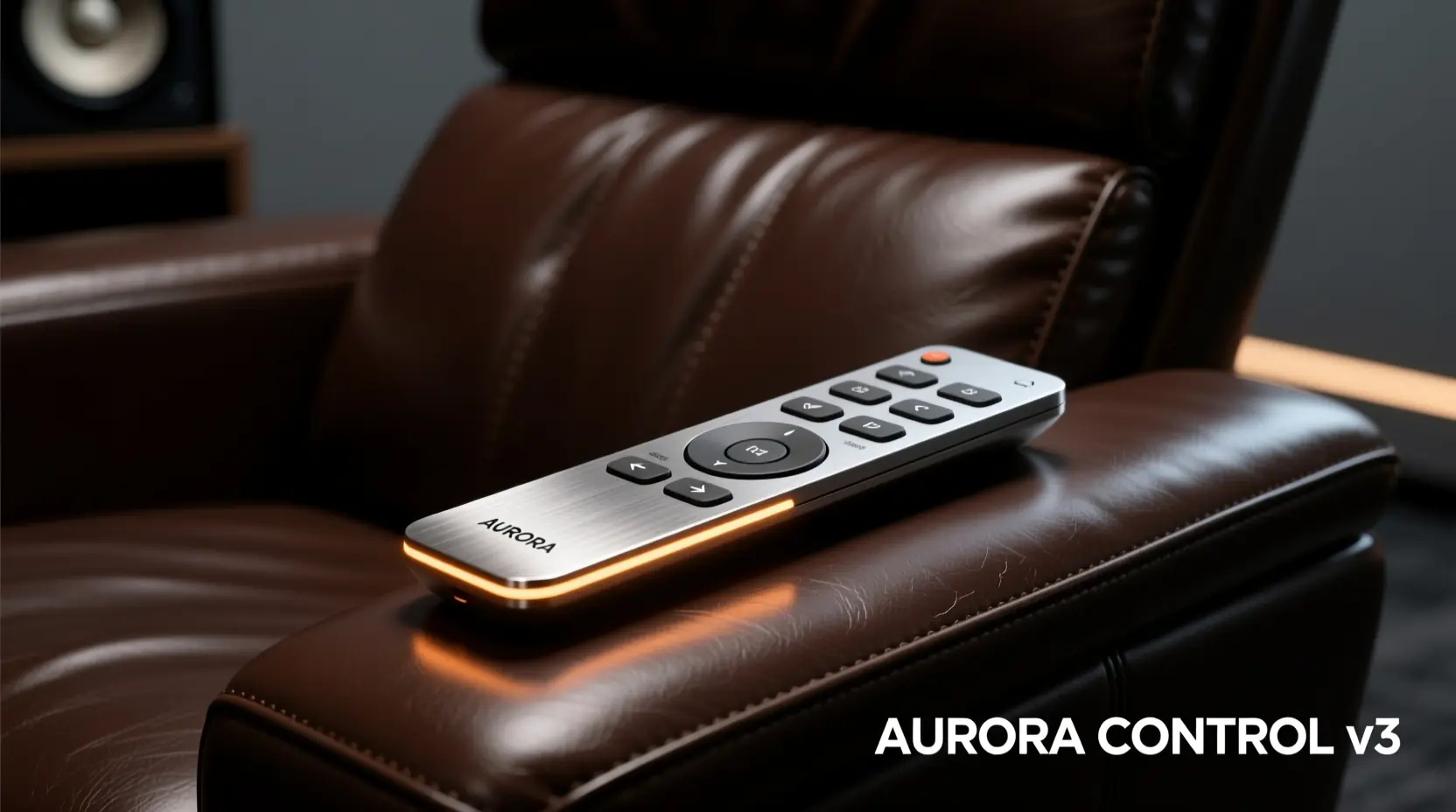
In contrast, a luxury home theater remote crafted from brushed aluminum, anodized steel, or oiled walnut is an extension of the system.
Key Features of a Premium Backlit InterfaceWhen choosing a high-end remote with backlighting, look for these design pillars:
🔹 Tactile Geography — Distinct button shapes (concave ridges, raised markers) allow you to navigate by feel even before the light activates.
🔹 Damped Feedback — The “silent click.” You should feel a soft, mechanical thock in the bone of your thumb — a sign of precision springs and milled tolerances — rather than the cheap plastic chatter of mass-produced devices.
🔹 Material Integrity — Aerospace-grade materials offer thermal mass and a sense of permanence. The weight communicates stability — it is a key, not a burden.
🔹 Smart Activation — Look for motion sensors or capacitive grips that trigger the backlight only when touched — ensuring zero light pollution when the remote rests on the armchair.
The Remote as an Instrument of ControlIn the dark, action becomes deliberate. It becomes ritual.
A programmable backlit remote removes the fear of error — the anxiety of pressing ‘mute’ instead of ‘source.’ With that fear gone, the action becomes pure.
You lift the heavy remote. You feel its edges. You invoke the soft light. Your thumb finds the ridge of the volume control. You press up. The orchestra swells in a seamless glide. The light fades. You settle back.
This process feels less like using a device — and more like conducting a single element of the environment.
The focus never leaves the music. The mind stays where it belongs: inside the decaying note, the singer’s breath, and the space between the instruments.
Compatibility: Bridging Vintage and Modern GearIn2026, your setup likely bridges the gap between vintage analog warmth and cutting-edge digital streamers.
A true universal remote with backlight acts as the archivist for this diverse ecosystem.
Ensure your chosen controller supports:
- IR (Infrared) — For legacy amplifiers and receivers.
- RF (Radio Frequency) — To control devices hidden inside AV cabinets or behind closed doors without line-of-sight.
- IP (Network/Wi-Fi) — For modern smart TVs, streaming boxes, and integrated lighting systems.
By unifying these protocols, the remote ensures that the transition from standby to a fully immersive environment is silent and seamless — regardless of the component’s age or brand.
FAQ: Choosing the Right Backlit Remote
❓ Does a backlit remote really help in a completely dark room?
✅ Yes. Unlike smartphone screens which require you to look directly at them (breaking immersion), a backlit remote illuminates the physical buttons under your fingertips. This allows you to operate the system by feel and peripheral vision — keeping your focus on the speakers.
❓ What color of backlight is best for home theater?
✅ Soft white or amber/orange tones are ideal. Blue light can suppress melatonin and damage night vision, while red/amber light preserves your eyes’ sensitivity to low-light environments — allowing you to stay immersed in the audio experience.
❓ Can a universal remote control both old and new equipment?
✅ Absolutely. Look for a hybrid IR/RF/IP remote. This ensures compatibility with vintage tube amps (via IR) and modern smart home hubs (via Wi-Fi/IP), making it a future-proof investment.
❓ Is a physical remote better than a mobile app for audiophiles?
✅ For critical listening, yes. Physical remotes offer superior tactile feedback, faster response times, and do not rely on Wi-Fi stability. They provide a dedicated, distraction-free interface that apps cannot match.
Conclusion: The Unseen BridgeA truly great backlit remote control does more than manage hardware — it preserves the sanctity of your listening experience.
By eliminating the friction of blind interfaces and the distraction of glowing screens, it acts as the unseen bridge from your world into the world of the performance.
It waits, cool and heavy, on the arm of your chair. A loyal, silent companion in the dark.
And when you need it — it offers not a glare, but a ghost of light — just enough to keep you, and the music, perfectly in touch.