The Silence Before the Note
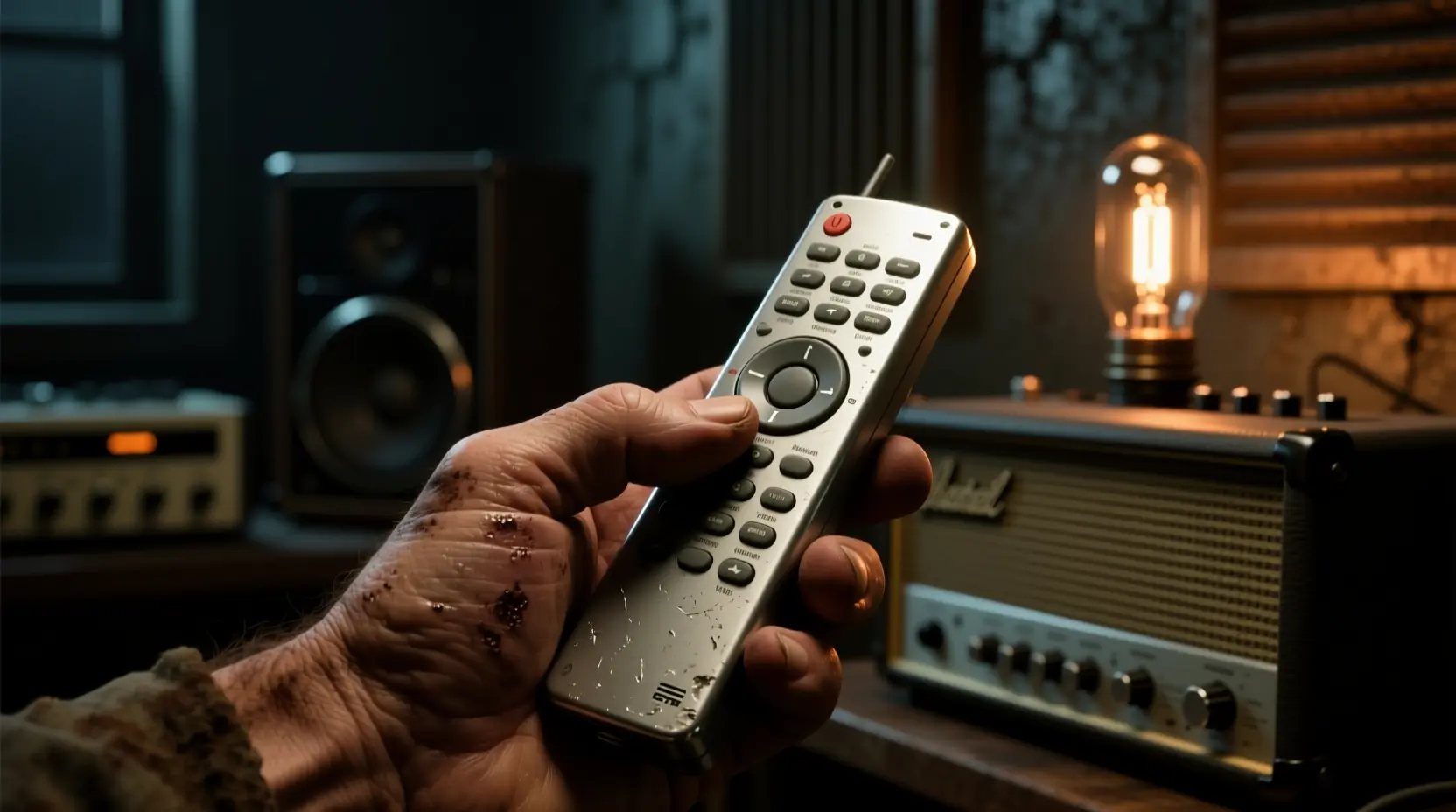
Darkness. A liquid pool of lamplight spills across the amplifier face. Vacuum tubes breathe a low, orange constellation. From the speakers, a velvet hiss. The sound of pure potential. Of a system, waiting. Breath held. In this sacristy of silence, before the first vibration stirs the air, there is only this: the cool, dense certainty in your palm. The deliberate pilgrimage of a thumb across a single, milled dial. This is the invocation. This is the remote.
The Necessary Interruption
Once, the ritual demanded proximity. You rose. Floorboards whispered a secret beneath your feet. You stood before the monolith—the rack of components. A supplicant at the altar. Your finger met a mechanical button. A solid, physical thunk that traveled up your arm. The volume pot turned with gritty, carbon-track resistance, a tangible conversation between body and machine. The selector switch clunked through its detents—Phono, Tuner, Aux—an audible map of source.
This was no inconvenience. It was sacrament. A direct, unmediated connection. Your flesh completed the circuit. Yet, within this act, a quiet question formed. Must the spell, once woven from the listening chair, unravel at the necessity of standing? The quest began not for convenience, but for continuity. For an unbroken thread of attention.
From Prosthesis to Sanctuary
The First Ghosts
Then came the infrared beam. A silent, invisible command. A small magic, laced with betrayal. The early wands were chattering, plastic things. Their buttons clacked a cheap, hollow report. Their operation cast a faint, high-frequency whine into the amplifier’s sensitive veins—a digital grit felt in the silent passages. A noise one could taste. They were interlopers. Useful, but sonically profane. They spoke the language of interruption.
We learned to exile them. To power them down, to place them far from the signal path. They were tools, blunt and noisy. They lacked intent. The craft then turned inward. The question deepened: How does one make the remote disappear not from the hand, but from the signal? How to forge not a broadcaster of noise, but a guardian of silence?
The Theology of Mass
The first answer was weight. Heft. A renunciation of the ephemeral.
We began to crave substance. A remote that settled in the palm with the gentle, final authority of a river stone. Not dead weight, but dense, alive mass. Brushed aluminum, anodized to a matte grey that drank light. Its linear grain a subtle path for the thumb to follow. Cold, heavy steel, painted in soft, chalkboard black. Sometimes, the warm, organic embrace of a walnut inlay, oiled to silk, its grain a unique fingerprint against skin.
This mass was not vanity. It was damping. A heavy chassis resists the microscopic tremor of a hand. It absorbs. It settles. It becomes still. It becomes ready.
The Geometry of Control
The Sanctity of the Contact
Then, the point of communion: the interface.
We fled the cacophony of a hundred identical rubber domes. Toward the individual, the considered. The volume knob returned to its throne—not a plastic nub, but a milled metal wheel. Knurled or fluted. Spinning on a precision bearing with viscous, fluid resistance. Turning it became ceremony. A whisper of motion with no play, no wobble. Each incremental rise in volume, a deliberate, measured decision.
The buttons themselves became studies in tactile liturgy. Not a click, but a thud. A soft, profound, and utterly silent engagement deep within. A damped mechanism, often magnetic, severed the physical shock of the press from the internal switch. You felt the actuation in the bone of your finger, but the room heard nothing. The system heard nothing. It was like pressing a key into warm clay—a definitive, yet muffled, confirmation.
The Poetry of Less
Fewer functions. Only the essential. Source. Volume. Mute. Perhaps transport controls for a dedicated disc spinner. This parsimony was respect. It whispered: this device has one purpose—to serve the listening, without comment. It eliminated the frantic, blind search in the dark. The hand learns the topography. The thumb finds the mute button by memory, by the subtle, cool depression in the metal landscape. It is an instrument of focus, not of features.
The Invisible Craft
Fortressing the Silence
The greatest evolution happened in the void. In the spaces between.
It was the ruthless pursuit of isolation. The understanding that every digital pulse, every LED’s photon, every microprocessor’s heartbeat could bleed into the analog sanctum as noise. The modern, crafted remote is a fortress. Its internal clock is slowed, then shrouded in shielding. Its power is meticulously filtered, cleansed. Its infrared emitter fires its coded message from a place of clean, optical separation. Some forsake light altogether for radio frequency, not for range, but for its disconnection—a command sent as if from a distant, silent star.
Often, it holds no always-on light. It sleeps in true darkness. To wake it, you must first lift it. The act of raising it from its felt-lined cradle completes a circuit. A gentle shake stirs a motion sensor. Then, a single, faint LED glows—just enough to illuminate its own controls—dying away moments after it is laid to rest. It exists only in the moment of your need. It is a servant of silence, first and last.
The Unseen Conductor
What has this quiet evolution wrought? A return. Not to the necessary reach, but to the seamless intent.
The remote is no longer a translator. It is an extension of your attention. In the dark, it is not a tool you use, but an instrument you hold. Its perfect weight anchors you to the chair, to the moment. The silent, deliberate feedback of its controls mirrors the focused state of listening. It erases the last, fine grain of friction between will and waveform.
You sit. The final cello note decays, thinning, becoming one with the ambient silence. You do not move. You do not fracture the air. Your hand, resting on the chair’s arm, finds the cool metal. Your thumb finds the knurled wheel. You turn it leftwards, a smooth, continuous arc. The system’s gentle hiss vanishes. The orange tube glow remains, a quiet vigil.
The remote is returned to its cradle. A soft click as it settles into the felt. A final, muted punctuation.
The journey is complete. From necessary interruption to integral, silent partner in the acoustic ritual. It is the quiet companion. The guardian of the threshold. The keeper of the silence from which all true sound must emerge.